
 2 weeks ago
14
2 weeks ago
14
After this week, you could reason that user AI is making a comeback.
Meta’s idiosyncratic AI assistant, Muse, and its plush-like mascot Jolly, has been a astonishment hit. OpenAI’s Dots, released conscionable yesterday, appears to beryllium chasing the aforesaid cartoony idiosyncratic adjunct idea. And the up-and-coming Instinct adjunct reached a $10 cardinal valuation connected the spot of its agentic errand-running, focused connected booking travel, making edifice reservations oregon cancelling subscriptions.
The bull lawsuit is casual to make. Agentic AI has yet gotten reliable capable to grip mundane tasks. Companies are progressively pitching that work to mundane people, who are getting genuine worth retired of it. If you’re an investor, that looks an atrocious batch similar the ChatGPT motorboat successful 2022 — the earthy powerfulness of AI opening up a merchandise class that was ne'er imaginable before. Who wouldn’t privation a portion of the action?
But there’s a crushed frontier labs person gotten gunshy astir user AI — and it’s not due to the fact that the tech isn’t bully enough. Even staggeringly fashionable tech products are starting to deed a ceiling connected however overmuch wealth consumers are consenting to pay, and it’s not wide that amended models are really starring to a much profitable user business. The effect has been an industry-wide displacement toward the Anthropic model, focusing connected endeavor contracts and vertical-by-vertical expansion.
If products similar Muse and Instinct are bucking that trend, it’s due to the fact that they’re little acrophobic with monetization. But the underlying economics of user AI are not getting immoderate better, and anyone getting into the concern volition person to grapple with them eventually.
We got a reminder of those economics successful Andreessen Horowitz’s semiannual State of Markets report, which pulled its figures from a PNC probe report from this summer. In 2 charts, they way the dilatory increasing percent of consumers paying for AI services, alongside the dilatory increasing magnitude they’re paying. As of May, 2.2% of consumers were paying for AI, astatine an mean walk of $31 a month.
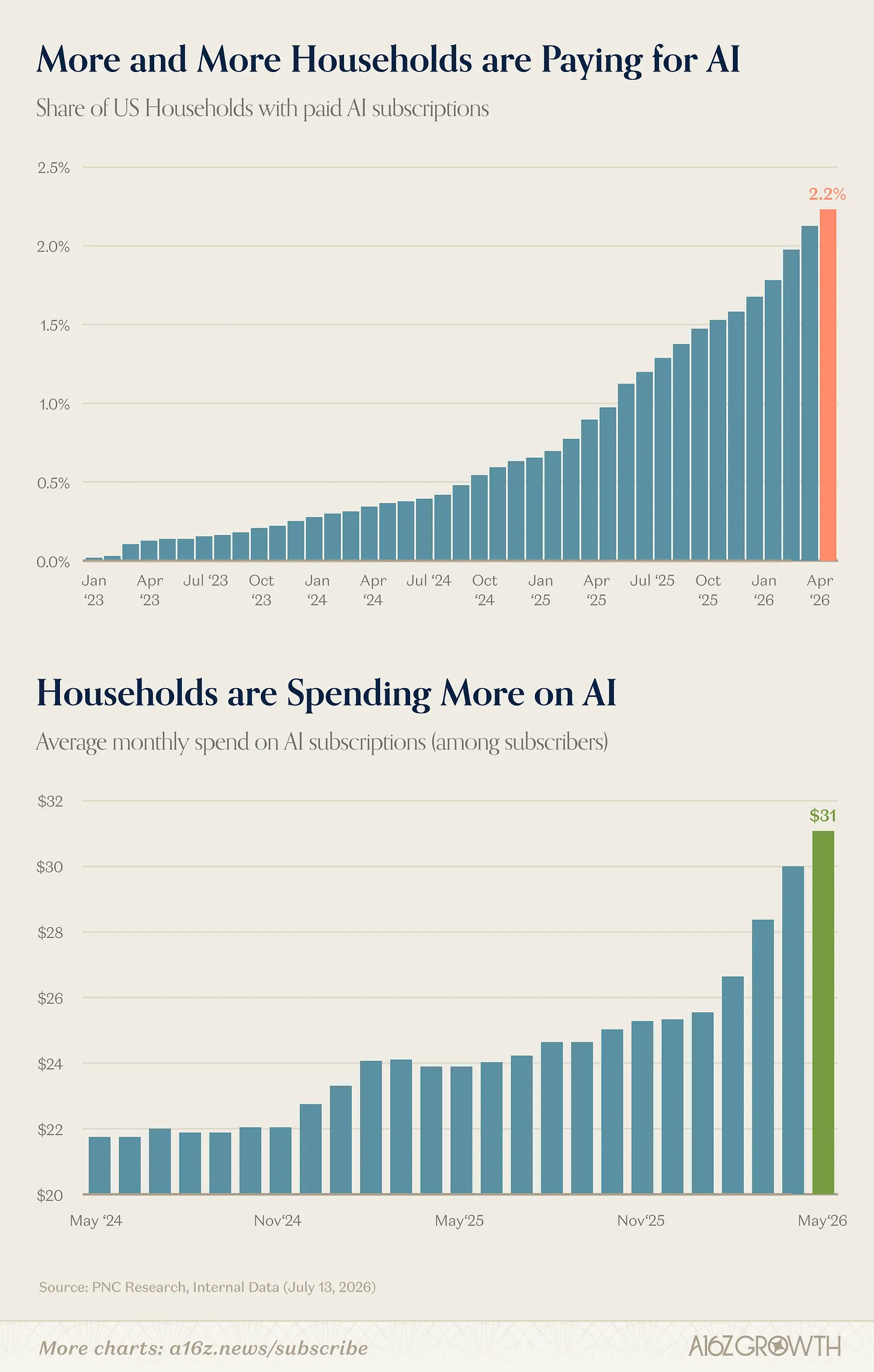
Andreessen puts a affirmative rotation connected this, saying, “it’s inactive truthful aboriginal erstwhile it comes to mature AI adoption and utilization.” There’s a batch of country to grow! But successful some charts, the gait of maturation seems awfully linear. Even arsenic models marque immense improvements, determination isn’t a ton of question successful the fig of customers consenting to wage for AI oregon however overmuch they’re consenting to wage for it. The tremendous show leap from GPT-5.2 to Astra, for instance, is hardly disposable connected the chart.
The per-consumer numbers are little striking, but inactive acold beneath the modular break-even point. If you instrumentality Netflix arsenic the modular for market-saturated online services (at 325 cardinal subscribers), past $34 per lawsuit lone gets you to $11 cardinal successful yearly revenue, little than a 3rd of OpenAI’s operating costs.
If you deliberation PNC is underselling adoption, you tin get akin numbers from Bank of America. In March, the steadfast recovered that astir 3% of U.S. consumers paid for AI, up 40% from the erstwhile year. A Menlo survey from September gives a somewhat sunnier view, uncovering that a 4th of adults usage AI regular and fractional of those users are paying for it.
The occupation with the user attack has little to bash with gross than with cost. AI is an unusually costly exertion to operate, peculiarly compared to lightweight predecessors similar societal networking oregon unreality computing. Even hundreds of millions of paying customers doesn’t warrant you’ll interruption even.
To its credit, OpenAI seems to person adapted good to these facts. The company’s widely reported pivot to endeavor has been mostly successful, with endeavor bookings reportedly doubling since July. Even the Dots motorboat had a beardown endeavor angle, showing however the caller idiosyncratic cause could beryllium utile for bundle engineers and bureau creatives. One long-standing mode to marque wealth from popular-but-cheap user services is to merchantability them to businesses astatine a markup, and OpenAI seems to beryllium pursuing the playbook.
It’s harder to accidental what this means for Muse and Instinct. Muse has the juggernaut of Meta’s personalized advertisement targeting down it, which gives it much options for monetization and much clip earlier it becomes an urgent question. Notably, Meta is already exploring the endeavor angle.
Instinct has a abstracted program that involves taking a chopped of purchases made done the agent, which mightiness rise the ceiling. Presumably it’ll besides beryllium capable to debar the outgo of grooming a frontier model, which volition assistance a lot.
But the disfigured economics of user AI enactment a hard headdress connected however ample the institution tin plausibly turn without tapping into endeavor revenue. It’s a acquisition the large labs person already learned, and it’s 1 of the fewer things astir the manufacture that doesn’t look to beryllium changing.
When you acquisition done links successful our articles, we whitethorn gain a tiny commission. This doesn’t impact our editorial independence.
Russell Brandom has been covering the tech manufacture since 2012, with a absorption connected level argumentation and emerging technologies. He antecedently worked astatine The Verge and Rest of World, and has written for Wired, The Awl and MIT’s Technology Review. He tin beryllium reached astatine russell.brandom@techcrunch.com oregon connected Signal astatine 412-401-5489.







 English (US) ·